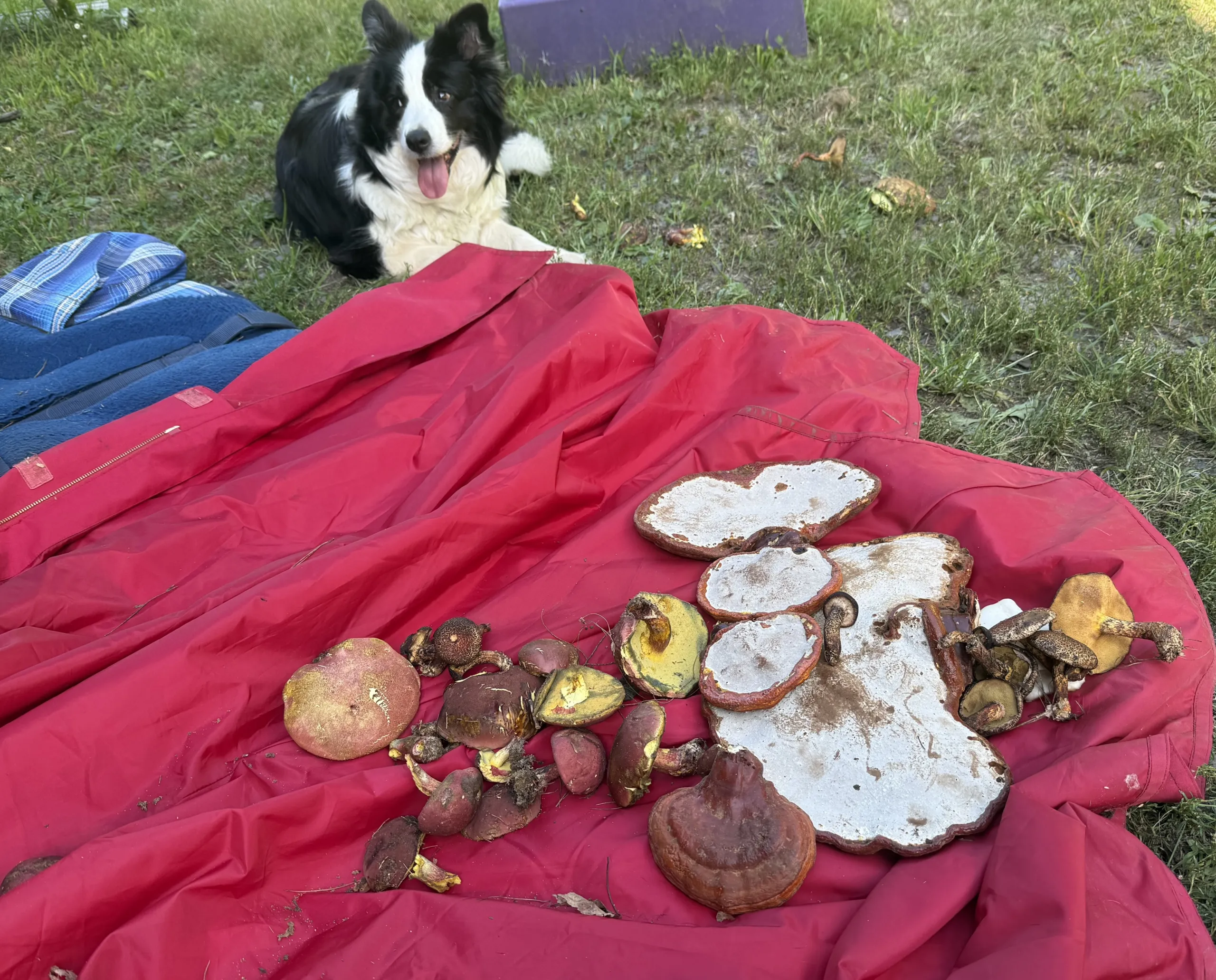
 This summer I have been riding into the Massachusetts woods in search of the beautiful red, lacquered Ganoderma Tsugae that grows here on eastern hemlock, which is a North American relative of the Chinese medicinal mushroom língzhī 靈芝. Being on horseback on my sturdy and eager horse, Spencer, allows me to cover more ground than I might on foot. Where I live, there are many miles of forest to explore so I set out for the hemlock groves.
Finding língzhī this way changes the conversation. Before we ask what it “does,” we can look at the mushroom itself.
Where does it choose to grow? What kind of tree supports it? How do we know when it is ready to gather or gone by? What does it feel and smell like when freshly gathered? Why is its upper surface so brilliantly red and lacquered, while underneath it is pale and densely porous? How does it change as it matures? And especially, how can I use the herb for myself and in clinic.
In China, zhī 芝 became associated not only with medicine, but with longevity, the nourishment of life, Daoist cultivation, and the mysterious ability to “lighten the body” (qīng shēn 輕身). Ancient texts describe different kinds of zhī, while later Daoist writings tell of adepts traveling into remote mountains to gather them.
The mushroom growing in our Massachusetts forests is the same genus but not the same species as the medicinal língzhī cultivated in China. The one I gather on hemlock is Ganoderma tsugae. But its close botanical relationship, striking physical resemblance, and overlapping chemistry raise a question:
Can I understand and use my local Ganoderma in a similar medicinal way as the cultivated one from China? And how do I use it?
These are some of the questions at the heart of the short class I’ll be teaching.
We’ll begin with the classical Chinese descriptions of língzhī , including the Shén Nóng Běn Cǎo Jīng, and look at why this mushroom came to occupy such an unusual place between medicine, food, longevity practice, and Daoist thought.
Then we’ll bring the discussion back into the body.
We’ll look closely at língzhī ’s physical qualities. its brilliant red surface, its pale porous underside, its dense woody structure, its relationship to moisture and decay, and consider what those qualities indicate from a Chinese medicine perspective. How does it work in the body? What does it do? We will compare this with modern science’s take on this question.
And importantly, we’ll talk about preparation and how it acts in the body from an East Asian medical point of view. What are ways that língzhī is prepared in China and how might this powerful medicine become an easy part of your diet as well as your patients.
If you would like to learn how I am approaching our local Ganoderma tsugae through the history, medicine, energetics, and preparation traditions of Chinese língzhī , I would love to have you join me. The recipes you’ll receive as printable cards to give your patients, will be a wonderful additon to all you offer in your clinic.
September 22, 2026, 1:00 – 2:00 PM EDT

Leave A Comment
You must be logged in to post a comment.