
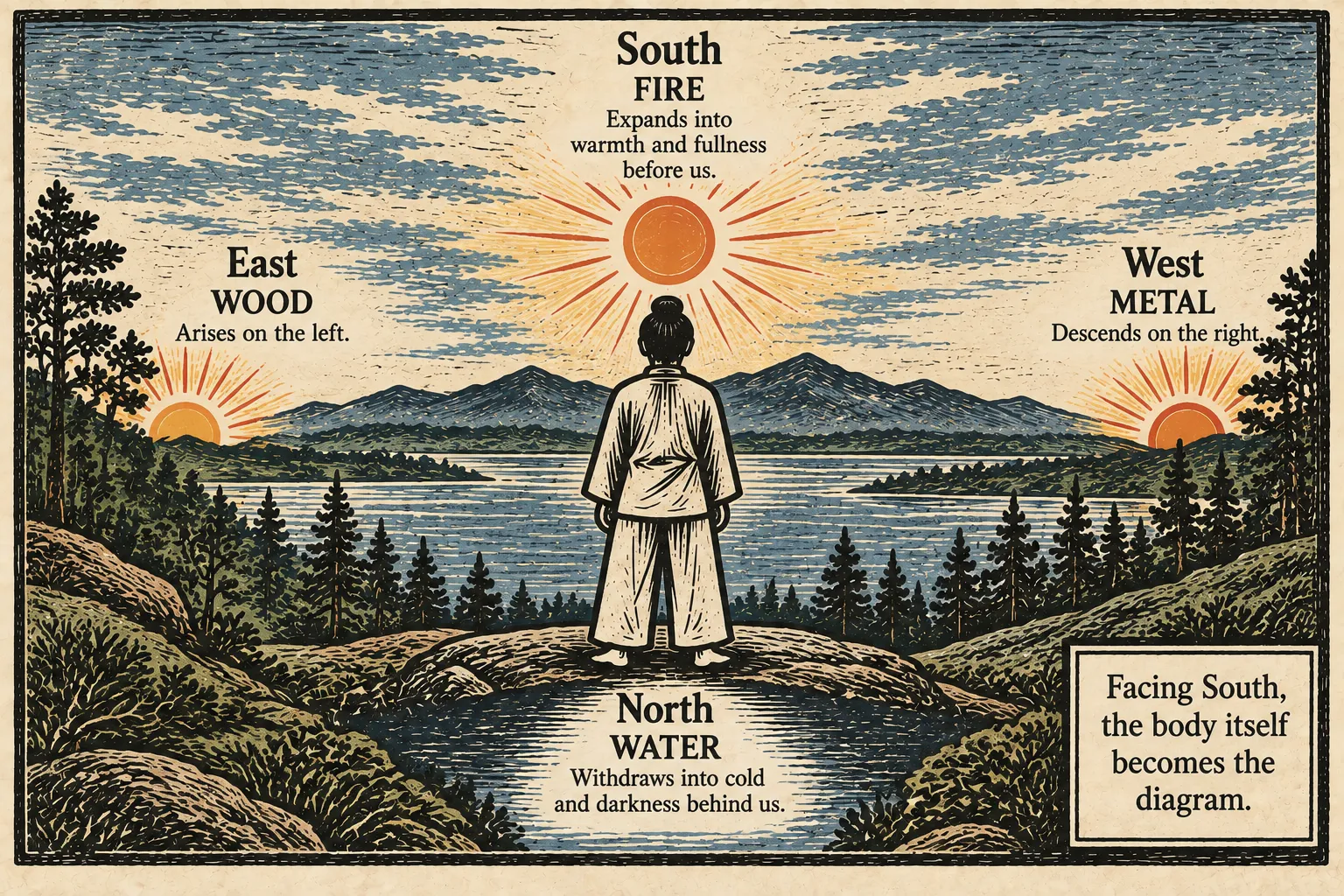
 One of the most beautiful instructions in the Nèijīng is also one of the easiest to take for granted: the sage faces south.
When we actually do this in the Northern Hemisphere, something remarkable happens. Facing south, east is on our left and west is on our right. The sun rises on the left, climbs toward its greatest warmth before us, descends on the right, and disappears toward the cold darkness associated with the north behind us. Suddenly the Five Phases are not simply concepts on a diagram. We can feel them.
The body itself becomes the diagram.
I have many students who live and practice south of the equator, and over the years this question has come up again and again: how do we understand these directional relationships in the Southern Hemisphere?
The problem with simply facing south
If you face south in Australia, the sun still rises in the east and sets in the west. Wood can still arise on the left and Metal descend on the right.
But something important has changed. In China, south is equatorward and therefore toward greater solar warmth, while north is poleward and toward greater cold. In Australia, this is reversed. North is equatorward and warmer; south is poleward and colder.
So if an Australian practitioner simply faces south and copies the traditional Chinese directional diagram, Fire points toward the colder poleward direction and Water toward the warmer equatorward direction. Something no longer fits.
Does this mean Southern Hemisphere physiology should be reversed? I don’t think so. Wood still arises, Fire expands and reaches fullness, Metal descends and gathers, Water stores, and from storage Wood arises again.
The problem is not the physiology. There are two geographical relationships that happen to coincide beautifully when one faces south in China:
east ↔ west: arising ↔ descending
equatorward ↔ poleward: heat ↔ cold
In the Southern Hemisphere, they no longer fit around a stationary human body.
One must rotate.
Try it with your own body
If you live in the Southern Hemisphere, go outside if you can and try this physically. Here is a meditation to help you:
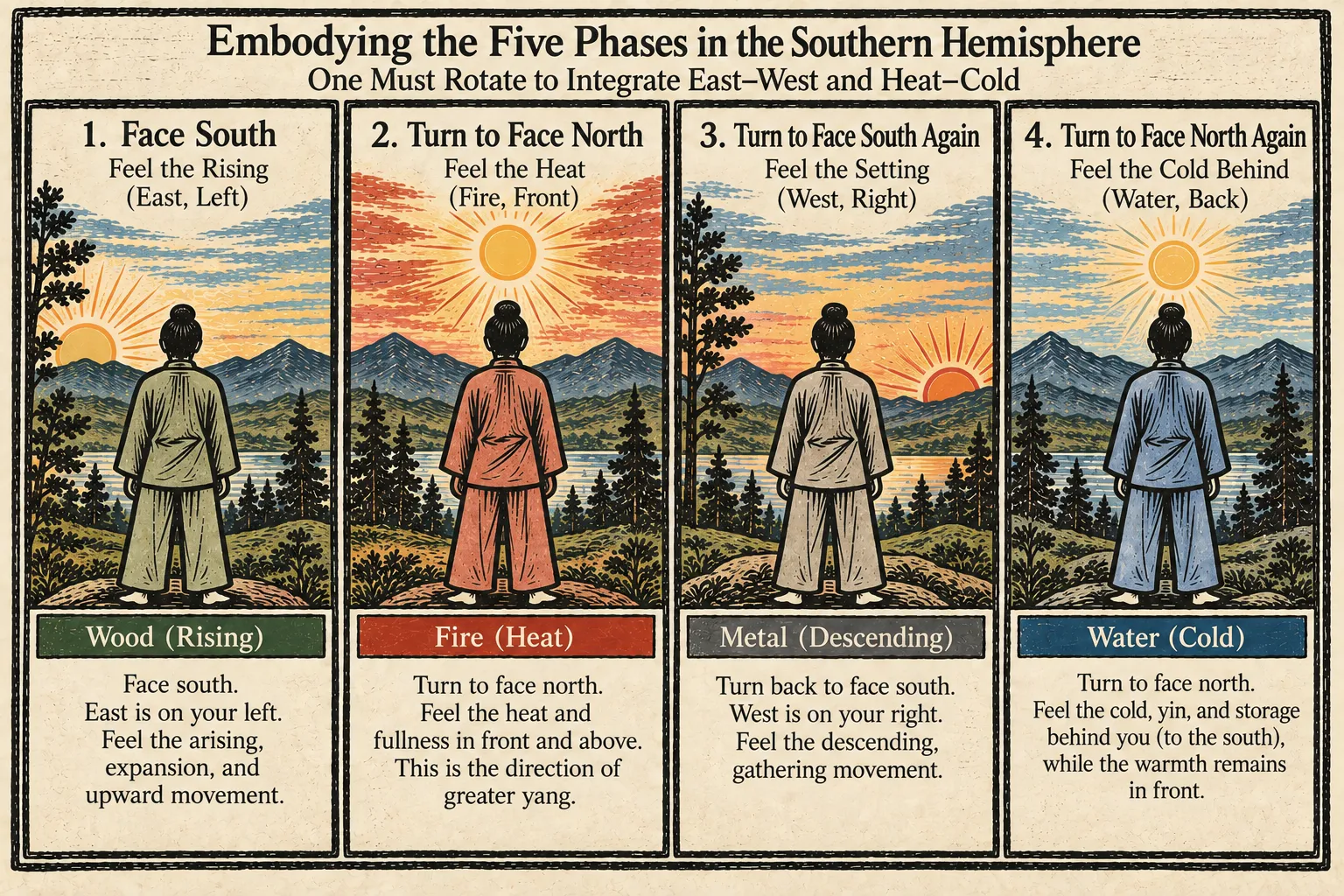 First, face south. East is on your left. Feel the movement of sunrise there. This is Wood: arising, emerging, extending upward and outward.
Now turn around and face north, toward the equator. Feel the greater warmth before you. This is Fire: expansion, fullness, and greater yáng.
Turn south again. West is on your right. Feel the setting sun and its descending movement. This is Metal: descent, gathering, drawing inward.
Finally, turn north again. Warmth is before you, while the colder, poleward direction is behind you to the south. Feel Water there: cold, storage, depth, and stillness.
The circle now contains a twist. The body has to turn to bring the east-west movement and the heat-cold movement together.
The Five Phases are movements before they are compass points
This raises a larger question about classical cosmology. Perhaps Fire isn’t fundamentally “south.” It is equatorward and therefore associated with heat, expansion, fullness, and the culmination of yáng. South expresses those qualities beautifully in the geographical world in which Chinese medicine developed.
Likewise, Wood isn’t merely east. East is where the sun arises and therefore manifests arising. Metal isn’t merely west. West is where the sun descends and therefore manifests descent and gathering. Water isn’t actually “north.” It is poleward and therefore expresses cold, darkness, contraction, and storage.
The directions reveal the movements. They are not the movements themselves.
A lesson from Indigenous cosmologies
This is where Indigenous cosmologies of the Southern Hemisphere offer something important to think about, while requiring respect and caution. There is no single “Indigenous Australian cosmology,” and Aboriginal and Torres Strait Islander traditions should not be treated as versions of Five Phase theory. Different peoples developed highly specific bodies of knowledge in relationship with their own Country.
What is especially interesting is that these cosmologies arose from the land, sky, waters, seasons, plants, animals, winds, rains, and celestial movements of the Southern Hemisphere itself. They were not Northern Hemisphere cosmologies transported south and then corrected to make them fit. They were not trying to solve the problem of a Northern Hemisphere diagram. The Southern Hemisphere was not a problem requiring correction. It was the world. Knowledge arose through relationship with that world.
That offers an important lesson without requiring us to borrow Indigenous teachings or claim that the traditions are equivalent: begin where you are standing.
For practitioners of East Asian medicine, the situation is different because we have inherited a cosmological language that arose somewhere else. We therefore have to distinguish the relationships being described from the geographical arrangement through which those relationships were originally expressed.
Pay attention to the actual sky. Pay attention to warmth and cold. Pay attention to where the sun arises and where it descends. Pay attention to the place where you are standing.
Fidelity to the classics may require looking up from the diagram
None of this is something the Nèijīng tells us to do in Australia. The medical classics were written in the Northern Hemisphere and do not give instructions for adapting their directional cosmology after crossing the equator. I offer this as an exploration rather than a doctrine.
But it raises an important question about what it means to be faithful to classical medicine. If we reproduce the Chinese directional diagram perfectly while standing beneath a sky that contradicts it, are we preserving the teaching, or are we preserving the diagram?
Perhaps the deeper fidelity is to the relationships the diagram is trying to show.
The sage isn’t floating above the Earth looking at a Five Phase chart. The sage has a body, and that body is standing somewhere. There is earth beneath the feet and sky overhead. The sun arises and descends. Warmth comes from somewhere. Cold comes from somewhere. Life emerges, flourishes, contracts, stores, and emerges again.
For practitioners in the Southern Hemisphere, perhaps the answer isn’t to reverse the body or pretend that the local world behaves like northern China.
Turn your body and look.
Then the Five Phases become not five fixed positions on a page, but living movements through which the human being finds their place between heaven and earth.


Leave A Comment
You must be logged in to post a comment.