
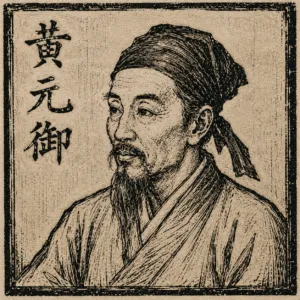
 One of the greatest challenges and joys of translating Huáng Yuányù (黃元御, 1705-1758) has been learning to resist a habit shared by both Chinese and English readers: treating two-character expressions as single vocabulary words.
Often this works perfectly well. But sometimes it obscures nuanced layers of meaning that remain available to the Chinese reader.
As I have been translating Sì Shèng Xīn Yuán (四聖心源, Heart Source of the Four Sages), I have come to appreciate that, for Huang, each character of the binome is essential. For a native Chinese reader, the individual meanings of two characters often remain quietly present, even when they are read together as a familiar expression. One does not consciously stop to analyze each character, yet their individual meanings may continue to resonate beneath the surface. English does not offer this luxury. Once a binome is translated as a single word, those resonances largely disappear. The reader receives the finished meaning but often loses the movement by which Huáng arrived there.
Again and again, I have found that Huáng’s binomes seem to describe not merely a state or an action, but a process or movement. The first character often initiates an action; the second reveals its consequence. Rather than simply naming a thing, Huang is showing it coming into being.
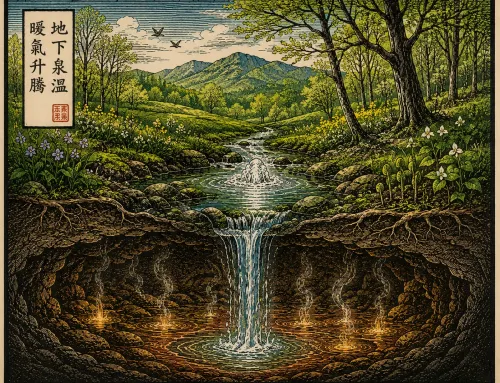
The insight that first led me to think differently about Huáng’s language came from the seemingly ordinary phrase wēn nuǎn (溫暖). In modern Chinese, it simply means “warm.” Most translations quite naturally render it that way. Yet I began to wonder why Huang chose these two particular characters instead of one.
If we allow each character to retain its own voice, a richer picture begins to emerge.
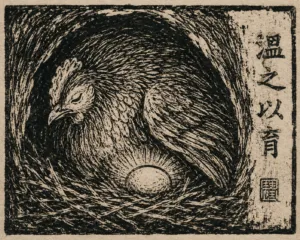 Wēn (溫) is not simply warmth; it is the gentle process of warming. In my own translation, I have come to think of it as incubating warmth. The image is one of quietly protecting and nurturing warmth so that life may awaken. It is the warmth hidden within the seed beneath the soil, or the warmth beneath the brooding hen that allows new life to develop. It is warmth being carefully nurtured.
Nuǎn (暖) is the next stage. The warmth has become established. It is now sufficient to generate life. Buds begin to swell, roots begin to grow, and the first shoots emerge from the earth. The warmth is no longer merely being protected; it has become life-giving.
Read this way, wēn nuǎn is not simply “warm.” It describes a transformation: incubating warmth so that warmth capable of generating life may arise.
To my mind, this beautifully reflects Huáng’s understanding of the wood phase. Spring does not suddenly become summer. Warmth is first quietly incubated, then gradually established until it is sufficient to generate new life. Only afterward does that life continue to mature into the exuberant flourishing of the fire phase, when the fully unfurled leaves receive the light of summer.
An English translation that simply says “warm” preserves the final state but loses the movement by which that state was achieved.
That question—“Why did Huang choose these two characters instead of one?”—has gradually become one of the guiding questions of my translation. Again and again, I have found that what first appears to be a simple two-character word often reveals itself as a description of process. The first character initiates an action; the second shows its natural fulfillment. Rather than merely naming a condition, Huáng frequently describes the body as something continually becoming.
This same dynamic seems to appear throughout Huáng’s writings.
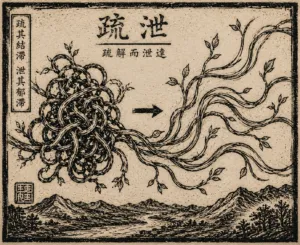
An example is shū xiè (疏泄), usually translated as “free coursing.” Yet shū (疏) means to untangle or loosen what has become knotted, while xiè (泄) means to release. Huang is not merely describing a physiological function. He is describing a process. One first untangles; then release becomes possible. In my own translation, I have rendered this as “untangling and release.” To my ear, it better preserves the sense that the second movement naturally follows the first.
Consider bō xuān (播宣). It would be easy to translate this simply as “disseminate.” But bō (播) means to sow or broadcast seed. It is an action. Xuān (宣) describes the free and unobstructed spreading out that follows. Essence and qì are first sown throughout the body so that they may then spread freely.
Or take gǔ dàng (鼓盪). It is often rendered as “stimulate.” Yet gǔ means to beat a drum, to rouse, or to initiate movement. Dàng is the sweeping surge that follows. The medicine does not merely stimulate. It stimulates so that movement may sweep through the body.
The same relationship appears in jiāo gù (膠固). Jiāo (膠) is becoming glue-like or adhesive. Gù (固) is becoming fixed. The pathology is not simply fixed. It becomes adhesive, and because it has become adhesive, it becomes firmly lodged.
Likewise, yōng zǔ (壅阻) is often translated simply as “obstruction.” Yet Yōng describes congestion, things crowding together. Zǔ is the obstruction that results. Congestion develops until blockage occurs.
Even Huáng’s descriptions of chronic disease seem to unfold in this way. Chén sù chán mián (陳宿纏綿) is often reduced to “chronic” or “lingering.” Yet each character contributes to the story. The disease becomes old (chén, 陳). It remains lodged (sù, 宿). Because it has remained lodged, it begins to cling (chán, 纏). Having become old, lodged, and clinging, it persists without interruption (mián, 綿). What first appears to be a string of near-synonyms instead reveals the natural history of a pathology.
Perhaps not every binome in Huáng is intended this way. But Hu´ng is remarkably delibrate about every character he uses, so I assume he had a good reason for choosing two characters instead of one. Whether every example ultimately supports this way of reading is almost secondary. Simply asking the question has transformed my reading of his work. Passages that first seemed repetitive often become remarkably precise. The language begins to reveal living processes rather than merely actions or static objects.
| Binome | Conventional translation (e.g., Wiseman) | Process-oriented reading | Condensed translation |
| wēn zào 溫燥 | warming and drying | warming so as to dry | warming to dry |
| wēn nuǎn 溫暖 | warm, warmth | incubating so as to deeply warm | incubating to warm |
| shū xiè 疏泄 |
free coursing | untangling so there may releasing | untangling and releasing |
| shōu liǎn 收斂 | astringing | gathering so there may be inward drawing | gathering and drawing inward |
| bō xuān 播宣 |
disseminate | sowing so as to freely spread | disseminating and freely spreading |
| gǔ dàng 鼓盪 |
stimulate | rousing so there may be sweeping movement | rousing and setting in motion |
| jiāo gù 膠固 |
firmly fixed | becoming glue-like so as to become fixed | glue-like and fixed |
| yōng zǔ 壅阻 |
obstruction | becoming congested so as to become obstructed | congested and obstructed |
| chén sù 陳宿 |
longstanding | becoming old and abiding | old and abiding |
Rather than asking, “What does this word mean?” I increasingly find myself asking, “Why did Huang choose these two characters instead of one?”
That is a fundamentally philological question. It treats Huang as a careful writer rather than merely a source of medical information. The act of asking that question has opened richer readings of his physiology, pathology, and therapeutic method. My hope is that it may encourage others to hear something of the movement and poetry that Chinese readers continue to sense intuitively in Huang’s original language.
Sharon, I can’t tell you how much I LOVE this! As I am reliant on translators, having this mind opening accessibility to the hidden meanings and so incredibly helpful. It underscores all you have taught in the Great Turnings as processes always in motion simultaneously transforming. Thank you again for this and all you do for the medicine and all of us.