
Zhīzǐ Gānjiāng Tāng for Sleep
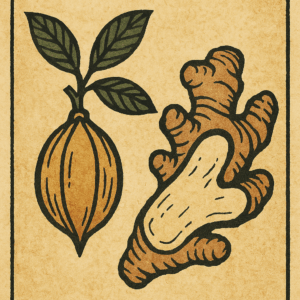 Zhīzǐ Gānjiāng Tāng is another teeny-tiny formula,[1] consisting of zhīzǐ, 3 g, and gānjiāng, 6 g. It is mentioned only in clause 80 of the Shānghán lùn, where it states, “In cold damage, the doctor used pills to purge strongly. Body heat remains, and there is slight vexation. Zhīzǐ Gānjiāng Tāng rules.
Let’s break this down a bit, starting with “cold damage.” Cold damage is often considered a term limited to the causative factor of the Máhuáng Tāng pattern. However, when thoroughly reading the Shánghān zábìng lùn, it is clear that Zhāng Zhòngjǐng used it in a much broader way than this. His use of the term cold damage can be summarized as an event that blocks the flow of the life-force yáng in the body. This is in contrast to the term wind-strike, which is also a much broader term than simply the causative factor causing a Guìzhī Tāng pattern. Wind-strike can be summarized as an event that leaves aspects of the body too open and thus prone to leakage. Hence, we have cold damage expressing blockage and wind-strike expressing leakage.
In this case, a blockage, cold damage, was understandably treated with strong purgation. Though we think of purgation and opening downward, it’s essential to understand that purgation, especially strong or excessive purgation, can also collapse and close the descending gastrointestinal pathways. When this happens, a new blockage can be created. In this case, the blockage is in the middle-soil, spleen, and stomach, and in the shàoyáng pivot. The life-force is unable to descend, and hence there is heat. This heat wafts upward, causing slight vexation.
Compared to the Zhīzǐ Chǐ Tāng pattern, we can see that, rather than a shàoyáng pivot/kidney pattern, this is a shàoyáng/soil pattern. It is not as deep as the Zhīzǐ Chǐ Tāng pattern. When the heart and kidney lose their connection due to the separation of root yīn and yáng, this is quite profound for the spirit and leads to the experience of anguish, especially at night when yáng is meant to root down into the water hibernation phase.
Dr. Tán Jiézhōng, 谭杰中[2] writes the following about this:
“The pattern of Zhi Zi Gan Jiang Tang has nothing to do with the disharmony between the heart and kidney, but is rather caused by the rising of deficiency heat and the sinking of spleen yang. The Zhi Zi Gan Jiang Tang pattern uses Gan Jiang to anchor and consolidate the spleen yang and Zhi Zi to descend deficiency heat. Because this pattern does not involve the issue of disharmony between the heart and the kidney, there is no symptom of “feeling anguish in the heart.” The Zhi Zi Gan Jiang Tang pattern does not involve a feeling in the chest, but rather a feeling of heat floating in the air….with vexation in the heart. One keeps thinking about things at bedtime and cannot fall asleep.”[3]
Though we often think of gānjiāng as an herb that warms the middle spleen, when used with bitter-cold herbs such as zhīzǐ, huánglián, or huángqìn, it is often described as a pungent-warm opening herb, used with bitter-cold descending herbs. In these types of patterns, the opening the middle power of gānjiāng is emphasized. Hence, in this formula pattern, it is not necessary to see a cold middle spleen. In this formula, gānjiāng is used to open the middle so that heat can descend with zhīzǐ’s help.
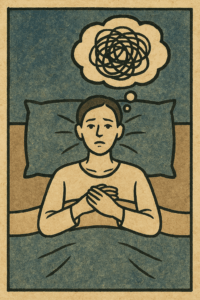 So, when might we consider prescribing Zhīzǐ Gānjiāng Tāng to help our patients with their sleep? I use this formula when I see an inhibited pivot[4] with insomnia characterized by unstoppable thinking. I also use it when the ministarial fire is flaring due to juéyīn blood deficiency in combination with blood nourishing herbs. These patients have difficulty falling asleep, or they wake up with many thoughts. These thoughts are not necessarily particularly distressing. Patients report that they know they don’t need to think about these things, but the mind just won’t stop. There may be a sense of irritability and restlessness. There may also be a mild sensation of floating heat. I will also ask whether their urine smells a bit strong or is concentrated, but if it isn’t, this won’t lead me away from this formula.
Zhīzǐ Gānjiāng Tāng is very effective for this pattern of insomnia. As a teeny-tiny formula, it is easily added to formulas such as Xiǎo Cháihú Tāng, Sì Nì Sǎn, or Cháihú Guìzhī Tāng. It is also a formula with very low dosages, making it a light formula. It is readily given in bulk for brewing as a late-afternoon tea.
[1] A teeny-tiny formula consists of two herbs
[2] 谭杰中 Tán Jiézhōng popular courses on TCM, including 《中医基础理论》, 《伤寒杂病论》, and 《庄子》
[3] Jingfangpai, accessed November 30, 2025, https://www.jingfangpai.cn/p/10053283
[4] Details about how to diagnose an inhibited pivot are taught in the White Pine Graduate Mentorship Program

Leave A Comment
You must be logged in to post a comment.