
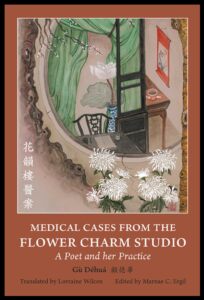
 The following is a preface to the recently published book “Medical Cases from the Flower Charm Studio” which was translated by Lorraine Wilcox and edited by Marnae Ergil. The preface is written by Sharon Weizenbaum. Here is an excerpt from the book to download
The book is currently available for purchase from the Purple Cloud Institute.
The job of a translator is not only to accurately render the original writer’s voice and intention but also to choose, among a plethora of possibilities, the text to translate. The choices are vast, given that a considerable percentage of Chinese medical written records have not been translated into English. In choosing Medical Cases from the Flower Charm Studio by Gù Déhuá, Lorraine Wilcox provides a great service to our community of practitioners.
This text records twenty-nine of Dr. Gù’s complex and often dangerous cases. In many instances, other contemporaneous published case records are quite short, giving only a simple intake, diagnosis, and formula choice with little discussion; frequently, doctors provided no more than the initial and follow-up formulas. In Dr. Gù’s records however, she takes the reader through up to fifteen clinical encounters with a single patient, allowing us to see how the terrain of the case shifts over time in response to her formulas. Dr. Gù also presents an explanation of her understanding of the pathogenesis and pathomechanism of the patient’s evolving condition. In addition to this detailed clinical picture, Wilcox provides her own notes, clarifying language and filling out our understanding of the pathology and historical context.
The cases that Dr. Gù shares are sometimes quite critical, with acute situations of fever, vomiting, bleeding, delirium, and falling into unconscious states. In fact, Dr. Gù is sometimes up against the threat of death and must act decisively and resolutely, a situation that, for a woman of her time, was not always easy. Hence, we are able to observe her clarity and courage to own what she knows and act on it. This may go against the family’s, other doctors’, or popular beliefs, but Dr. Gù is firm in her expression and willing to take this risk to save a patient’s life. For example, in Case 5, a patient who was fainting and panicked with “shivering chills and booming heat” was diagnosed by another doctor with a “fatal condition of taxation detriment.” Dr. Gù asserts confidently that she thought he was wrong. In fact, the opposite was the case, and the constrained fire needed to be cleared and freed. Dr. Gù stridently pushed the patient to basically “get out of her own head”, eat, and not avoid fresh air. Dr. Gù’s frank and upright approach is inspiring.
We also have much to learn from Dr. Gù’s herb and formula choices. Having focused a significant amount of my own translation choices on pathologies that involve cold and lack of yáng, I especially appreciate that many of the cases involve the chaos and damage that can be caused by unrestrained heat. Though it is evident from the cases that Dr. Gù has an in-depth knowledge of Zhāng Zhòngjǐng’s Discussion of Cold Damage (Shānghán Lùn) and Essentials of the Golden Cabinet (Jīnguì Yàolüè), she has also clearly mastered the myriad ways those patterns can transform into heat and fire, as expressed in Wú Táng’s Systematized Identification of Warm Diseases (Wēnbìng Tiáobiàn). Her cases and herbal choices deserve comprehensive study as they clarify the clinical usage of warm disease formulas in a wide variety of cases.
As for Dr. Gù’s use of herbs and formulas, I am particularly struck by her skill with phlegm-fire. When constrained heat combines with internal fluids, a dangerous mix ensues. Heat scorches and agitates, while phlegm can obstruct the orifices and consciousness. This mix puts many of Dr. Gù’s patients in a critical state. The physician must use cooling and moistening herbs without making the phlegm worse and must use phlegm-transforming herbs without exacerbating the heat. This is delicate and precise work. Dr. Gù shares with us her careful navigation as she walks this razor’s edge and brings her patients to safety and health.
Wilcox’s introduction to Dr. Gù’s text is a critical essay regarding women’s history as physicians. She shows that women doctors were both a necessary part of the health care for women, filling a role elite male doctors preferred to avoid, and that women doctors were generally held in contempt throughout Chinese history. Without female doctors, given the misogynistic cultural structure in China, women were often left without any care or only the care of an herbal granny or medicine granny. Dr. Gù, however, was remarkable in that she was literate and trained. She was not only a doctor for gynecological and reproductive illnesses; she treated women for all their illnesses, whether or not they were related to menstruation, pregnancy, or birth. Wilcox discusses ten women mentioned in history books, asking, “How many more never made it into the history books, after all, history books were written by the men who disdained them? How many more treated patients but never wrote books? How many more wrote books that have been lost? I think we can assume that these ten women are just a small fraction of the whole. There have always been, and there will always be, female doctors. May more of them come to light!”
 Wilcox writes, “One might be tempted to say these women doctors were gynecologists, but in reality, they specialized in female patients, treating any disorder a woman or girl might have.” Although Dr. Gù is not explicit about this, I believe that Wilcox rightly assumes that all of the patients mentioned in her cases are women. Dr. Gù was therefore required to be a fully informed, capable general physician for her patients as well as to understand and work skillfully with the female body’s inner workings and unique vulnerabilities. Though many of Dr. Gù’s cases do relate to menstruation, pregnancy, and birth, many of them do not. In the non-gynecological cases, these women express their disease just as a man would. Hence, any physician who treats women effectively must be twice as educated as those who do not. In addition to being a general physician, she must also be able to understand the body from the perspective of female presentations, something that most male, elite physicians either were unable or did not want to do.
Through this translation, we are shown how lucky we are that Dr. Gù’s case records survived and that we have a translator who found them and has chosen to render them into English for us to read and contemplate. This is an inspiration to all present-day female practitioners. Lorraine Wilcox’s excellent translation of this important text is a gift to our profession.
Sharon Weizenbaum
Founder of the White Pine Circle and White Pine Institute
Instructor of the White Pine Graduate Mentorship Program

Leave A Comment
You must be logged in to post a comment.