
Upcoming Jing Fang Intensive in Beautiful Girona, Catalonia Region of Spain

2026-02-09T22:55:18-05:00By |Blog, Classic Formulas, Diagnosis, Our Courses|

This March in Girona, Catalonia, I’ll be teaching Diagnostic Skills for Classical Formulas, a focused two-day course for students and practitioners who want to move beyond surface familiarity and develop clear, reliable diagnostic thinking grounded in classical medicine. Using live clinical cases, we’ll work directly with what patients present—observation, pulse and abdominal palpation, and careful questioning—and show how these findings cohere into meaningful patterns that naturally guide treatment with classical formulas. Core frameworks such as yīn–yáng, the five phases, and the six conformations will be used as practical tools rather than abstractions, with classical texts approached systematically and always in service of application. Set in the historic, walkable city of Girona, this teaching emphasizes method over memorization and cultivates a way of thinking that remains clinically alive long after the course ends.
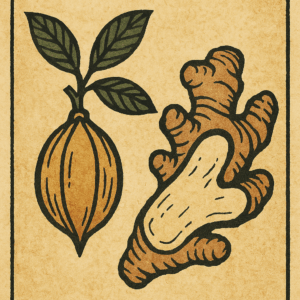
Zhīzǐ Gānjiāng Tāng for Overthinking Insomnia

2025-12-10T12:11:20-05:00By |Blog, Chinese Translation, Classic Formulas, Diagnosis, Individual Herbs, Our Courses|

Zhīzǐ Gānjiāng Tāng for Sleep

Zhīzǐ Gānjiāng Tāng is another teeny-tiny formula,[1] consisting of zhīzǐ, 3 g, and gānjiāng, 6 g. It is mentioned only in clause 80 of the Shānghán lùn, where it states, “In cold damage, the doctor used pills to purge strongly. Body heat remains, and there is slight vexation. Zhīzǐ Gānjiāng Tāng rules.
Let’s break this down a bit, starting with “cold damage.” Cold damage is often considered a term limited to the causative factor of the Máhuáng Tāng pattern. However, when thoroughly reading the Shánghān zábìng lùn, it is clear that Zhāng Zhòngjǐng used it in a much broader way than this. His use of the term cold damage can be summarized as an event that blocks the flow of the life-force yáng in the body. This is in contrast to the term wind-strike, which is also a much broader term than simply the causative factor causing a Guìzhī Tāng pattern. Wind-strike can be summarized as an event that leaves aspects of the body too open and thus prone to leakage. Hence, we have cold damage expressing blockage and wind-strike expressing leakage.

In this case, a blockage, cold damage, was understandably treated with strong purgation. Though we think of purgation […]

Zhīzǐ Chǐ Tāng for Insomnia with Anguish

2025-12-03T13:56:25-05:00By |Blog, Classic Formulas, Diagnosis|

In the last post, I wrote about two formulas for insomnia, Zhīzǐ Chǐ Tāng and Zhīzǐ Gānjiāng Tāng. Zhīzǐ Chǐ Tāng is an odd, teeny-tiny formula, and the way it works may be difficult to understand, especially the use of dàndòuchǐ, which we probably learned as primarily an herb for resolving the exterior. In this post, I will explain the mechanism of this formula as I understand and use it. How does it treat “anguish in the heart” type insomnia?

Before diving into that, I want to share a recent message from a student who suffered from a rash after a profound loss:

“I kept thinking about how you talked about Zhīzǐ Chǐ Tāng and how it was for anguish in the heart. That word, anguish,  is exactly how I’ve been feeling from the moment of loss.
Anyway, I took some ideas from the formula you originally suggested for me, which already had zhǐshí and zhīzǐ, and added a high dose of dàndòuchǐ, and it was like a lock-and-key magic!  After 3 1/2 months of this rash being so, so stubborn, it started to change dramatically. For the last week and a half, every morning when I wake, the rash is better and better, and I even think something feels a little emotionally lighter as well.
So thank […]

Differentiating Several Patterns that can Explain Insomnia

2025-10-27T17:35:31-04:00By |Blog, Classic Formulas, Neijing, Our Courses, Shang Han Lun Physiology|

One of my students, Polina Shneyderman, recently posted her results using Zhīzǐ Chǐ Tāng as follows:

I wanted to share a case that was helped so much by a tiny formula I learned from Sharon in her GMP. I have a patient who is a textbook Guìzhī Tāng pattern and who has done really well on different modifications of Guìzhī Tāng. She has Ehlers-Danlos Syndrome, where her body produces too much collagen, and as a result, she has heart palpitations, agitation, and very loose joints. Guìzhī Tāng has helped with heart palpitations, periods, cold, and body aches. One thing I could not tackle was her waking up before her alarm in the morning, feeling a sense of terror or fear of missing something important.
I learned from Sharon that there is a formula called Zhīzǐ Chǐ Tāng—zhīzǐ and dàndòuchǐ—and that it can help with this kind of terror. I added these two herbs to her formula, and she now sleeps soundly and peacefully until her alarm wakes her up. The bonus—her blood pressure is normal now, too—patients with EDS tend to have dangerously low blood pressure.
Just wanted to share a success story and thank Sharon and other White Pine mentors who help us all be better clinicians.

In the next post, I will discuss this […]

Zǐwǎn (紫菀, Aster tataricus) for Constipation

2025-11-24T10:02:08-05:00By |Blog, Chinese Translation, Individual Herbs, Opening Through|

I am currently in a translation workshop, led by Stephen Boyanton, with Lorraine Wilcox and others. The quirky cases Lorraine shares are a constant delight for the participants. Recently, she shared a case in which the doctor spun the patient on a home-made wheel until he vomited to obtain a cure for the patient’s insanity. In another case, the patient had a lump due to grief, and the doctor successfully treated him by teasing him until he laughed so hard he could barely stand it. These cases are wonderful and will hopefully find their way into a book for all to enjoy and learn from.

Today, Lorraine posted this case in our new White Pine Circle Translation Support Group. It is from Volume 2 of 俞弁《續醫說》 Xù Yī Shuō by Yú Biàn (1522, Míng):

宋蔡元長苦大便秘,國醫用藥,俱不能通利,蓋元長不肯服大黃故也。時史載之未知名,往謁之閽者,齟齬久之,乃得見既而診脈,史欲出奇曰:請求二十文錢。元長問何為,曰:欲市紫菀耳。

(Northern Sòng dynasty prime minister) Cài Yuánzhǎng suffered constipation. The Imperial Doctors used herbs, but nothing could free his stool. It was probably because Cài Yuánzhǎng was not willing to take dàhuáng. At the time, Shǐ Zàizhī was not a well-known doctor. He called on Cài, but the gatekeeper argued with him for a long time. Eventually, Shǐ got to see Cài and took his pulse. Shǐ was about to leave and strangely asked for 20 coins. […]

Go to Top