
Using Zhīzǐ Gāncǎo Tāng in a Case of Esophageal Pain
2026-02-16T07:57:26-05:00By |Blog, Chinese Translation, Classic Formulas, Individual Herbs|

I am teaching a short class on zhīzi, February 18th at noon, EST as part of the single herb series. I hope you can come and spend some time with this wonderful herb! Though zhīzǐ does not lead one of the famouns Ten Key Formula Families, it is a profoundly important and I would say KEY medicinal in my clinic. In this class you will learn how to recognize when to use zhīzǐ and how it is used in classical formulas.  It is free to White Pine Inner Circle members and you can register HERE.

In preparation for the class and to show zhīzǐ’s use for esophageal pain, I am publishing the following case by Dr. Qi:  

我喜欢吃糯米黏糕,而且不管吃什么速度都很快,是急性子。在宴会上或者和朋友一起吃饭,我搁下筷子时,再看周围的人,一般刚刚吃一半。鉴于这种情况,我努力让自己慢慢吃饭,可是这种小时候形成的习惯,很难改变。因为这种急性子,就不时有被热茶烫嘴或喉咙被烫疼的事情发生。

I enjoy eating sticky rice cakes, and I eat quickly no matter what I am having. I have an impatient temperament. At banquets or when dining with friends, by the time I put down my chopsticks, I often notice that others have only finished half their meal. Although I try to slow myself down, habits formed in childhood are difficult to change. Because of this impatience, I have occasionally burned my mouth or throat

一次,当急急忙忙地吃下 1 块热的烤年糕时,感觉食道疼痛,大概是引起了食道烫伤。随后即使进流食也感觉胸口堵塞样疼痛。

Once, when I hurriedly swallowed a piece of hot baked rice cake, I felt pain in […]
Zhīzǐ Gānjiāng Tāng for Overthinking Insomnia

2025-12-10T12:11:20-05:00By |Blog, Chinese Translation, Classic Formulas, Diagnosis, Individual Herbs, Our Courses|

Zhīzǐ Gānjiāng Tāng for Sleep

Zhīzǐ Gānjiāng Tāng is another teeny-tiny formula,[1] consisting of zhīzǐ, 3 g, and gānjiāng, 6 g. It is mentioned only in clause 80 of the Shānghán lùn, where it states, “In cold damage, the doctor used pills to purge strongly. Body heat remains, and there is slight vexation. Zhīzǐ Gānjiāng Tāng rules.
Let’s break this down a bit, starting with “cold damage.” Cold damage is often considered a term limited to the causative factor of the Máhuáng Tāng pattern. However, when thoroughly reading the Shánghān zábìng lùn, it is clear that Zhāng Zhòngjǐng used it in a much broader way than this. His use of the term cold damage can be summarized as an event that blocks the flow of the life-force yáng in the body. This is in contrast to the term wind-strike, which is also a much broader term than simply the causative factor causing a Guìzhī Tāng pattern. Wind-strike can be summarized as an event that leaves aspects of the body too open and thus prone to leakage. Hence, we have cold damage expressing blockage and wind-strike expressing leakage.

In this case, a blockage, cold damage, was understandably treated with strong purgation. Though we think of purgation […]

Two Excellent Zhi Zi (栀子Gardenia Fructus) Formulas for Sleep

2025-11-24T10:31:39-05:00By |Blog, Classic Formulas, Individual Herbs|

As a continuation of the discussion on using classical formulas for sleep issues, I will now introduce two very effective zhīzǐformulas: Zhīzǐ Chǐ Tāng and Zhīzǐ Gānjiāng Tāng. As you recall in the previous post, my student Sylvia described the use of Zhīzǐ Chǐ Tāng and how she differentiated the pattern.

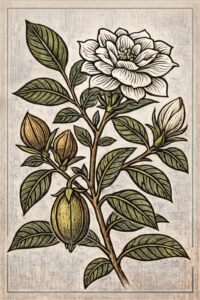
First, let’s talk about zhīzǐ. It is the fruit of the gardenia plant. In his poem, Shěn Zhòu[1] of the Ming Dynasty described the gardenia flower like this:

“雪魂冰花凉气清”

Snow ghost, ice flower, with its clear, cold Qi

According to Shen Nong Ben Cao Jing, zhīzǐ‘s flavor is bitter and its nature is cold. It is said to enter the heart, lung, stomach, liver, and San Jiao channels.[2] It is effective in discharging fire and dispelling vexation, clearing heat through benefiting urination, cooling blood, and resolving toxins.

Zhīzǐ‘s key action is to disinhibit the shàoyáng great sweeping motion. The motion of shàoyáng is to pivot. The shàoyáng pivot is responsible for pivoting imperial fire, which has descended into the body through the joint motions of shàoyīn and yángmíng, into its position within the body as ministerial fire. If the shàoyáng pivot motion is inhibited, the descending heat, which is none other […]

Zǐwǎn (紫菀, Aster tataricus) for Constipation

2025-11-24T10:02:08-05:00By |Blog, Chinese Translation, Individual Herbs, Opening Through|

I am currently in a translation workshop, led by Stephen Boyanton, with Lorraine Wilcox and others. The quirky cases Lorraine shares are a constant delight for the participants. Recently, she shared a case in which the doctor spun the patient on a home-made wheel until he vomited to obtain a cure for the patient’s insanity. In another case, the patient had a lump due to grief, and the doctor successfully treated him by teasing him until he laughed so hard he could barely stand it. These cases are wonderful and will hopefully find their way into a book for all to enjoy and learn from.

Today, Lorraine posted this case in our new White Pine Circle Translation Support Group. It is from Volume 2 of 俞弁《續醫說》 Xù Yī Shuō by Yú Biàn (1522, Míng):

宋蔡元長苦大便秘,國醫用藥,俱不能通利,蓋元長不肯服大黃故也。時史載之未知名,往謁之閽者,齟齬久之,乃得見既而診脈,史欲出奇曰:請求二十文錢。元長問何為,曰:欲市紫菀耳。

(Northern Sòng dynasty prime minister) Cài Yuánzhǎng suffered constipation. The Imperial Doctors used herbs, but nothing could free his stool. It was probably because Cài Yuánzhǎng was not willing to take dàhuáng. At the time, Shǐ Zàizhī was not a well-known doctor. He called on Cài, but the gatekeeper argued with him for a long time. Eventually, Shǐ got to see Cài and took his pulse. Shǐ was about to leave and strangely asked for 20 coins. […]

Go to Top