
In the last post, I wrote about two formulas for insomnia, Zhīzǐ Chǐ Tāng and Zhīzǐ Gānjiāng Tāng. Zhīzǐ Chǐ Tāng is an odd, teeny-tiny formula, and the way it works may be difficult to understand, especially the use of dàndòuchǐ, which we probably learned as primarily an herb for resolving the exterior. In this post, I will explain the mechanism of this formula as I understand and use it. How does it treat “anguish in the heart” type insomnia?
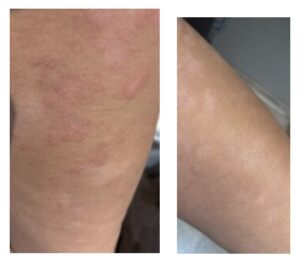
Before diving into that, I want to share a recent message from a student who suffered from a rash after a profound loss:
“I kept thinking about how you talked about Zhīzǐ Chǐ Tāng and how it was for anguish in the heart. That word, anguish, is exactly how I’ve been feeling from the moment of loss.
Anyway, I took some ideas from the formula you originally suggested for me, which already had zhǐshí and zhīzǐ, and added a high dose of dàndòuchǐ, and it was like a lock-and-key magic! After 3 1/2 months of this rash being so, so stubborn, it started to change dramatically. For the last week and a half, every morning when I wake, the rash is better and better, and I even think something feels a little emotionally lighter as well.
So thank you! I had your voice in my head with words of wisdom guiding me :)”
Here are the before and after pictures she sent me:
Let’s talk about Dàndòuchǐ (淡豆豉 Sojae Semen Praeparatum)
Dàndòuchǐ is a lightly fermented preparation of black soybeans. It is prepared by steaming the beans and fermenting them with specific herbs (like Qīnghāo 青蒿) until aromatic. This is different from culinary dòuchǐ. It is milder and specifically processed for medicinal purposes.
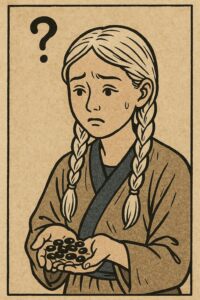 When I first learned about dàndòuchǐ, it was as a cool, pungent, exterior-releasing herb, as in cōngchǐ tāng. Even at that time, about 40 years ago, I remember thinking it was odd that a heavy bean resolved the exterior. In general, herbs that resolve the exterior are light, leaves, twigs, and flowers, so I was confused by dàndòuchǐ’sclassification. Formulas and Strategies writes, “dàndòuchǐ is lightweight and floating in nature, with good venting, dispersing, and disseminating actions.” When I read this, I got that dizzy feeling you get when you’re gaslit. Beans are not lightweight. They are relatively heavy, even when prepared. One can tell when looking at them. In addition, the Shénnóng Bĕncăo Jīng, Míngyī biélù, and Formulas and strategies all say that dàndòuchǐ is bitter. The motion to resolve the exterior is up and out, the purview of the pungent flavor. Bitter descends. Though fermentation makes it lighter and qīnghāo also lightens it, it still feels like a stretch to me to call it a light herb, and it remains without a pungent flavor.
This was only partially explained in Formulas and Strategies as follows: “Because of its mild character, it is also appropriate for treating patterns of yin deficiency with superimposed exterior disorders.” Of course, most herbs that resolve the exterior are pungent and sweat-inducing, so one must always be cautious when using them with people who have yin deficiency. Yet, dàndòuchǐ is appropriate for yin deficiency.
I also knew from my early studies that dàndòuchǐ is useful for irritability and vexation, as in Zhīzǐ Chǐ Tāng. How does that work? I remained confused.
Beans, in general, are chalky, which means they increase the absorptive function of the organ to which they home. The soybeans of dàndòuchǐ are black in color and hence home to the kidneys. Thus, dàndòuchǐ enhances the kidneys’ absorptive function.
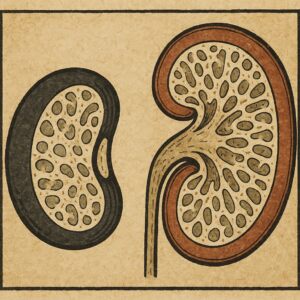 It was not until I read material written by a Taiwanese doctor, 谭杰中 Tán Jiézhōng[1], that I understood how dàndòuchǐ does its job. He writes: “Beans have the structure of the kidneys, and their shape resembles the kidney zang. Black beans are black, making them even more like the actual structure of kidneys. The slightly cold black beans, after being fermented and cooked into dàndòuchǐ, can help the kidneys take in moisture and steam it upward to fill the body. In order to prevent the original water and fire qì from colliding and causing discomfort, the kidney water qi steamed up by the dàndòuchǐ is pushed toward the top of the head. In addition, to allow the heart fire to penetrate the rising kidney water energy, zhīzǐ is used. zhīzǐ is an herb that can move fire downward.”
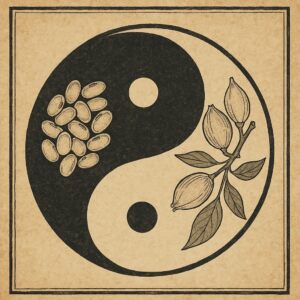 In Zhīzǐ Chǐ Tāng, we can see that zhīzǐ moves pathologically rising fire due to an inhibited pivot, downward toward the water phase zāng, kidneys. Dàndòuchǐ helps the kidneys absorb water, receiving and integrating this guided fire into cool water. When fire is inside water, the water can steam up to the surface of the body. Hence, this is truly a formula to assist communication between the heart and kidneys by opening the pivot and supporting kidney qì to absorb fluids.
Understanding the mechanism of dàndòuchǐ, we can see why it is useful for patients with yin deficiency: it helps the kidneys absorb fluids. Dr. writes, “Ancient formulas use dàndòuchǐ to treat common cold; when the common cold disease evil is in the body, dàndòuchǐ can fill the body with kidney energy and force the evil out.” This helps explain that the use of this herb for an unresolved exterior. It shows us the specific circumstances in which we would use a formula such as cōng chǐ tāng.
There are a few other symptoms, other than anguish, that often appear with the Zhīzǐ Chǐ Tāng pattern:
- Hot or concentrated yellow urine
- Tossing and turning at night
- Stuffy chest
- Heat feeling in the chest
- A feeling of a lump in the esophagus
In summary, Zhīzǐ Chǐ Tāng treats kidney deficiency with inhibited pivot type insomnia. The anguish comes from a felt sense of deep emptiness along with the pathological shàoyáng heat. Relief comes when the heat is guided, uninhibited, back to the kidneys where cool water awaits it. The cool water is also steamed back up to calm the heart. Since Zhīzǐ Chǐ Tāng is a teeny-tiny formula, it is easily added to other formulas as with my student/patient above. We can see that the same mechanism was at play with her rash as well.
- [1] 谭杰中 Tán Jiézhōng popular courses on TCM, including 《中医基础理论》, 《伤寒杂病论》, and 《庄子》


Leave A Comment
You must be logged in to post a comment.